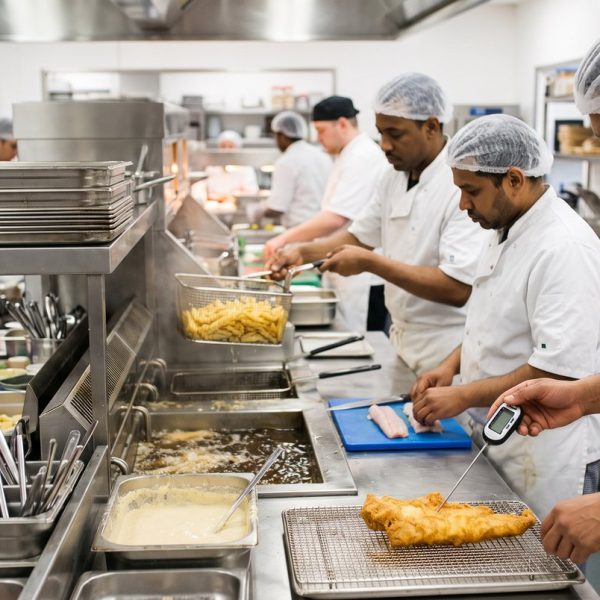
Walk into the kitchen of almost any busy British chippy or restaurant on a Friday night and you may hear four or five languages before the first order goes out. That diversity is a strength, but it raises a practical question every owner has to answer: does everyone on the line truly understand your HACCP food safety procedures? A plan that only the manager can read is a plan that protects nobody.
Food safety rules do not change because a team speaks Polish, Romanian, Bengali or Portuguese. What changes is how you make sure those rules are understood, followed and recorded every single shift.
What HACCP asks of a food business
Hazard Analysis and Critical Control Points, usually shortened to HACCP, is a structured way of identifying where food can become unsafe and controlling those points. In the UK, food businesses are expected to put in place and maintain procedures based on its principles, and official guidance on food safety management systems explains what inspectors look for.
The seven HACCP principles are easy to list and harder to live by: analyse the hazards, identify critical control points, set critical limits, monitor them, decide on corrective actions, verify that the system works, and keep records. In a fish and chip kitchen those control points include delivery temperatures for fresh fish, chilled storage, frying temperatures, hot holding, cleaning between raw and cooked areas, and the handling of the fourteen major allergens.
Why language gaps become safety gaps
Most kitchen mistakes are not acts of carelessness. They come from misunderstanding. A new cook who half understands "discard after two hours" may read it as "check after two hours". A porter who cannot read the cleaning schedule may skip a step without realising it matters. When an environmental health officer asks a member of staff to explain what they do if the fridge reads 9°C, a hesitant answer can lower your rating even if the paperwork is perfect.
Allergen control is the most sensitive area. A server who cannot clearly understand which dishes contain gluten, fish or mustard puts customers at real risk, and the consequences can be severe. Translating your allergen matrix and procedures is not a courtesy. It is part of managing the hazard.
Translating your HACCP plan the right way
You do not need to translate every page of a lengthy HACCP plan. Focus on what staff actually use: the critical limits, monitoring instructions, corrective actions and daily record sheets. Keep the master document in English for inspectors, and produce clear translated working versions for the kitchen.
Use a professional translator who understands catering vocabulary. "Core temperature", "hot holding" and "cross-contamination" have precise meanings, and a vague rendering defeats the purpose. Ask for short, direct sentences, consistent terms across every document, and numbers left exactly as they are, so that a temperature or time never changes in translation.
Bilingual layouts work well on the kitchen wall. A cooling chart with English on the left and the second language on the right helps staff learn the English terms they will hear from supervisors, while making sure the instruction itself is understood. Pictograms for handwashing, colour-coded boards and probe checks add another layer of clarity.
Food safety training for a multilingual team
Paper alone does not create a safe kitchen. Food safety training has to reach people in a language they understand. Many accredited providers now offer Level 2 courses in several languages, and some offer HACCP training materials with translated workbooks. Where courses are only available in English, a short translated summary sheet and a supervisor who checks understanding in practice make a big difference.
Practical demonstrations are the best test. Ask each cook to show you how they probe a portion of cod, what they write on the log and what they do if the reading is too low. If someone cannot explain it, the issue is usually language or training, not willingness. Broader experience from companies that train staff across borders shows the same thing, and this article on growing teams globally makes the case well for investing in clear, translated onboarding.
Menus, labels and the customer side
Food safety does not stop at the pass. International customers need to understand what they are ordering, especially when allergens are involved. Accurate menu translation helps visitors make safe choices and reduces the number of confused questions at the counter on a busy night.
Make sure translated menus stay in step with your allergen matrix. If a supplier changes the batter mix or you switch frying oil, every language version needs updating at the same time.
Keeping it current
A HACCP system is a living document. Review it whenever the menu, equipment or suppliers change, and at least once a year even if nothing seems different. Each review is a chance to check that translated versions still match the English master and that new starters have received the same training as everyone else.
The payoff is real. Clear, well-translated procedures mean fewer mistakes, more confident staff, smoother inspections and, above all, customers who can trust what lands on their plate.